CASE STUDY / 2026 / SINGTEL
ROLE
Experience strategy, product design, ecosystem design, cross-functional leadership
YEAR
2026
TEAM
Myself as design lead, 1 identity designer, 1 My Singtel App design lead, 1 designer
DURATION
8 months
One login ecosystem — designed to make usage across every channel feel continuous, personal, and secure.
A six-month pilot to create a common identity layer for Singtel’s main brand: replacing Onepass (current username/Password login mechanism), enabling SSO, moving toward passwordless access, and opening secure service management to more user types.
PROBLEM
Singtel did not have a holistic view of its customers.
Every sub-brand, platform, and user type had its own way of logging in. Mobile OTP, email OTP, network login, username and password. On top of that, two distinct user tiers — account holders and service users — each with their own flows, across different products, on different platforms. The result: we could never fully identify a user. And if we couldn't identify them, we couldn't know them. And if we couldn't know them, we'd never get ahead of their needs.
This wasn't just a UX problem. It was a strategic one.

Image: Disparate logins
DIRECTION
One identity layer to power every Singtel product.
The vision was simple — build a common identity layer that aggregates all user data under one ID. One login that pulls from a shared knowledge base, so we can preempt needs, pick up where users left off, and make every interaction feel personal.
My team was to design the new login mechanism across Singtel's main brand as a pilot, while feeding into the broader unified platform initiative. Goals: replace Onepass, enable SSO, go passwordless with PIN and biometrics, reduce OTP, and open access to new user types — broadband, TV, non-Singtel users.
DESIGN PRINCIPLES
✅ Ask for effort once; everything after should feel effortless.
✅ Never pass the problem to the user.
✅ Design for the edge case, not just the happy path.
✅ Phase delivery. Timelines are real; phasing should protect the vision.
PROCESS
Step 1: Anchor the identity
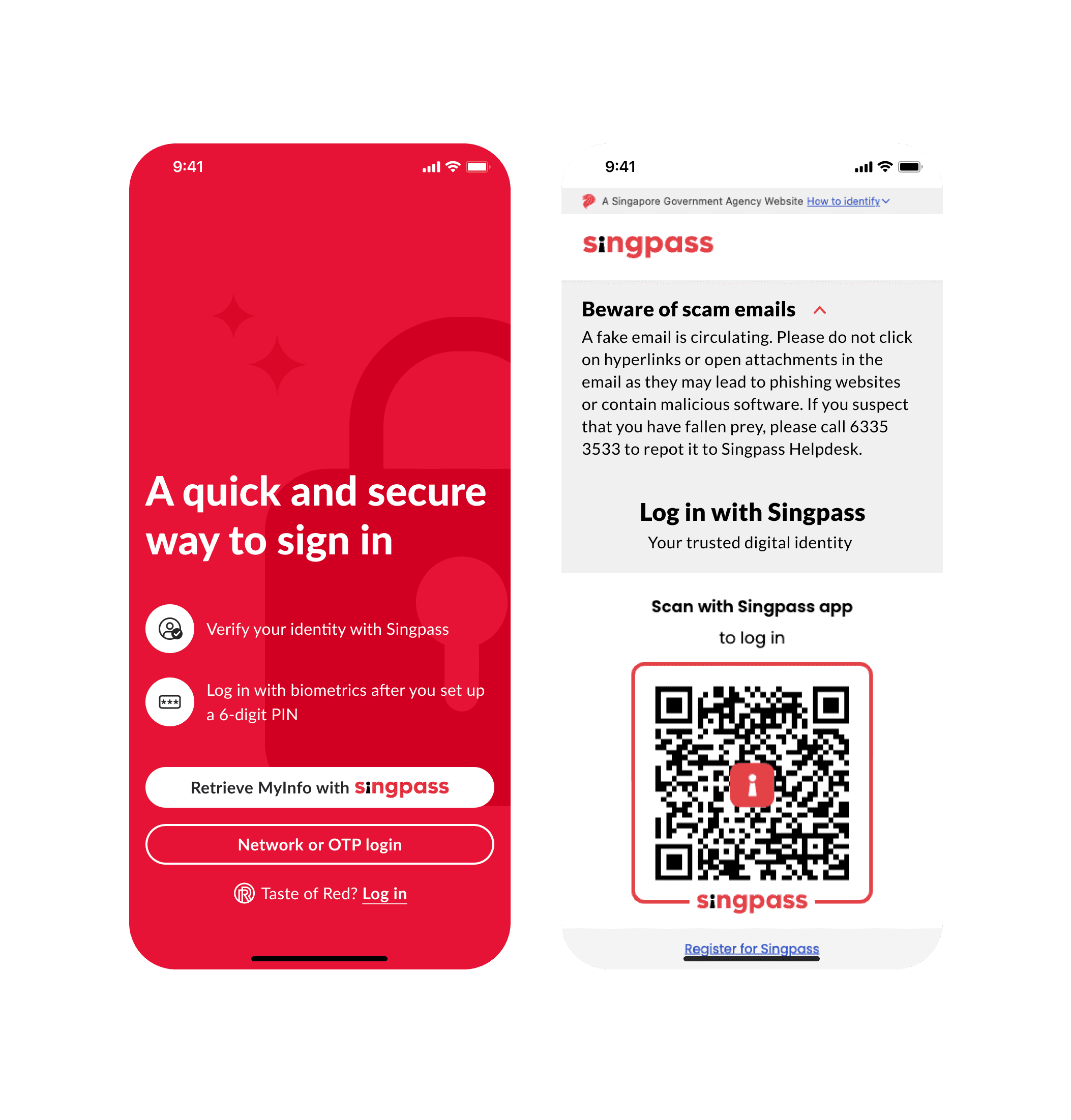
We aligned on Singpass as the cleanest identifier — IMDA's 2024 eKYC mandate had already made national ID the anchor for line registration. One-time MFA setup, biometric or PIN every time after.
Step 2: Solve for every user type
Verifying with Singpass worked for account holders — the people who bought and registered the service. But not everyone who uses a Singtel service owns the account.
A teenager on a family broadband plan. A flatmate on a shared TV subscription. They weren't in our system. No account, no credentials, no way in. Something goes wrong — you'd call the account holder, or worse, use their login. Neither acceptable.
The team opted for the easiest solve; asking users to enter their service ID + email/mobile OTP. I pushed back. Most broadband or TV users don't know their service ID. Many broadband accounts had no email on file. We'd be creating a new category of failure.

Image: Rejected approach
Sending an invite link to broadband and TV service level users was the better option.
We looked at how Spotify and Singapore Power handled account sharing — and landed on an invite-link model. Account holder invites the service user. Scoped, secure access. No credentials shared. It required more time to build — so we phased it.

Image: Final approach (Future build)
SOLUTION
Step 3: Phase the delivery.
Phase 1: All account holders and only mobile service users verify once at onboarding via Singpass. Every login after = biometric or PIN
We audited and culled: account creation flows, password resets, legacy support content. We redesigned a single login landing page — one entry point for every Singtel application. MFA set up, QR scan, straight in.
One experience. Every product. Every user type. And the foundation for what comes next — a unified identity platform that lets Singtel finally know its customers, fully.

Image: Mobile App MFA onboarding

Image: Web push authentication
Upcoming builds
Phase 2: Invitation link for TV and Broadband service users
Phase 3: Once most customers have been onboarded onto MFA, incorporate into buyflow. I held back the online shop rollout deliberately — the buy flow needed to be seamless from day one, not interrupted by onboarding to a new login.
RESEARCH & VALIDATION